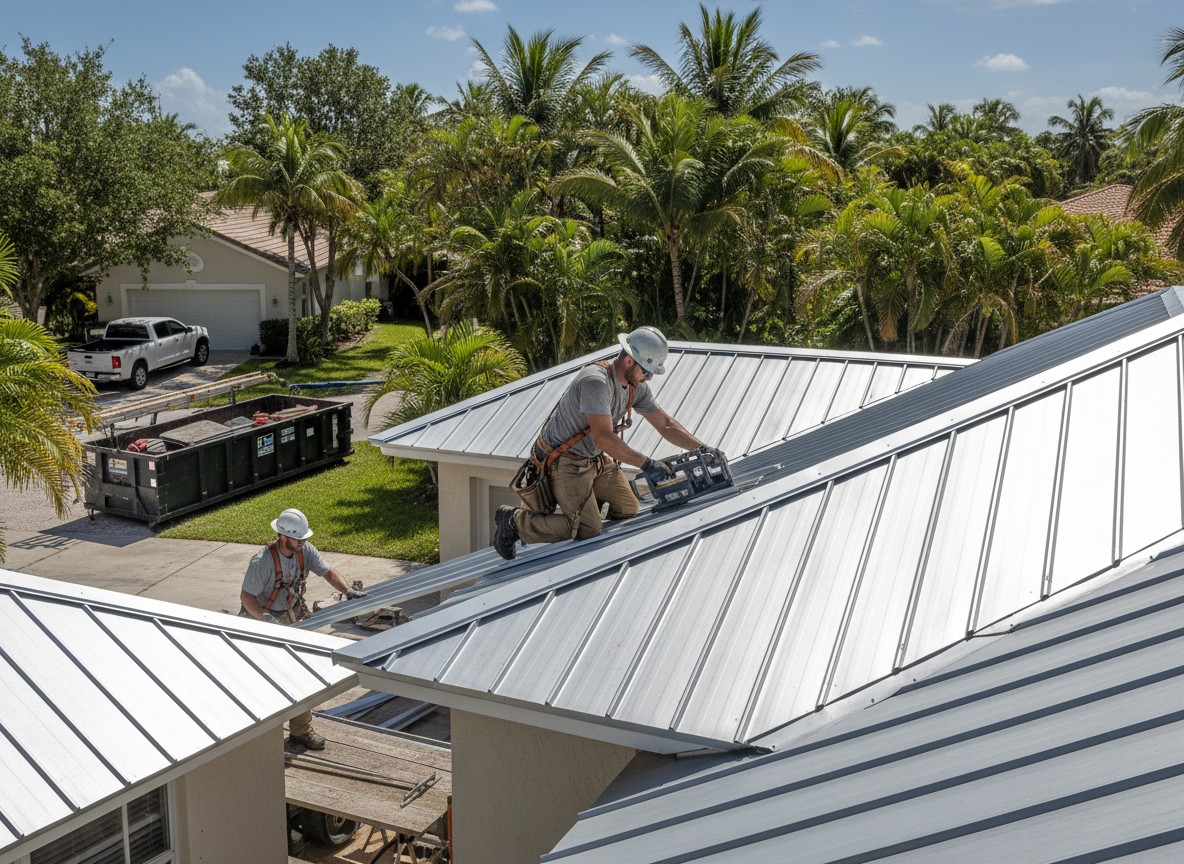
Metal roof installation in Coconut Creek requires attention to the area's frequent heavy rains and high humidity that accelerate corrosion on fasteners and seams. Homes built from the 1970s through the 1990s often have trusses spaced at 24 inches that demand specific clip spacing and thermal breaks to prevent oil-canning. Panels must be selected for 140-plus mph wind ratings common in Broward County, with sealed closures at every ridge and eave to stop wind-driven water intrusion during summer thunderstorms.
Proper underlayment choice matters here because the substrate on many Coconut Creek roofs is plywood that has already seen decades of moisture cycling. Self-adhering membranes under the metal prevent leaks at penetrations such as HVAC curbs and skylights that are common on single-story ranch homes. Edge details around the many flat-tile and barrel-tile neighbors also require custom flashing so the new metal roof does not create water channels onto adjacent structures during the intense afternoon downpours typical from June through October.
Fastener selection and torque settings change with the aluminum or steel gauge chosen for coastal proximity. In Coconut Creek, installers must account for thermal expansion over long runs because daytime roof temperatures regularly exceed 140 degrees. Leaving the wrong gap at endlaps leads to buckling within the first two seasons. Ventilation upgrades are often paired with the new roof to reduce attic heat buildup that drives up cooling costs in the long, humid summers.
Technician insight
In Coconut Creek, the thing that catches most people out with Metal Roof Installation is underestimating how fast the afternoon thunderstorms drive water under poorly sealed ridge caps on older 24-inch truss homes; we always add extra butyl tape and custom closures because the humidity never gives the roof time to dry out between rains.
Replacing a leaking asphalt roof on a 1987 Coconut Creek ranch
The homeowner reported water stains along the living-room ceiling after repeated summer storms. Inspection showed deteriorated shingles and rusted nails on 24-inch trusses. We removed the old roof, installed self-adhering underlayment, and fit 24-gauge standing-seam panels with sealed ridge closures. No further leaks appeared after the next hurricane season.
How it works
- 1
Site Assessment
Measure existing roof, check truss condition, and note all penetrations on Coconut Creek homes.
- 2
Material Selection
Choose gauge, color, and coating rated for local wind and salt exposure.
- 3
Underlayment and Flashing
Install ice-and-water shield at eaves and valleys plus custom step flashing at walls.
- 4
Panel Installation
Set standing-seam or screw-down panels with correct clip spacing and expansion gaps.
- 5
Final Inspection
Check all seams, fasteners, and ridge vents before cleanup.
Pricing
Cost depends on roof size, panel profile, gauge, and number of penetrations; we provide upfront written quotes after inspection.